The History of Cannabis Prohibition
Before Criminalization
Did you know that cannabis was not always illegal in the United States? In fact, its only within the last 100 years that it was made illegal!
The earliest laws about the cannabis plant was actually one that predates the country's founding! For example, in 1619, a law was passed in the Virigina colony that required every farm to grow cannabis and produce hemp, which was a very important commodity at the time.
Over time, cannabis started being used as a medicinal product. The earliest people who used cannabis recreationally were supposedly Mexican immigrants in the early 1900s.
Reefer Madness
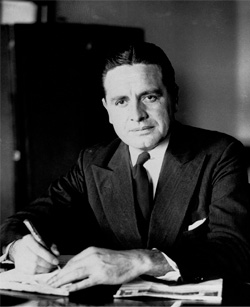
Harry J. Anslinger
Once alcohol prohibition was lifted in the 1930s, a lot of people shifted focus onto cannabis to demonize. Harry J. Anslinger was a man who was appointed to the Federal Bureau of Narcotics, which was the predecessor to the modern-day DEA. Harry, in his infinite wisdom, thought that it wasn't enough that cocaine and heroin were illegal. He felt that the amount of people who used those drugs were a tiny minority of people and wasn't enough for the agency to stay alive on enforcing those laws. So he decided to make it his mission to rid the US of all drugs, especially cannabis.
He propagandized against cannabis in ways to scare the public. Making claims that cannabis makes you psychotic, and finding the most questionable examples of people going crazy and blaming it on cannabis. He would claim that it would make you violent. He really latched onto a story about a man named Victor Licata, who killed his family with an ax, supposedly while high. However, it was discovered years later that there was a history of mental illness in the family, and there was no proof that he actually used cannabis.
One of the worst things was he contacted 30 scientists, and 29 out of 30 of them said that cannabis was not a dangerous drug. However, he took the advice of the one scientist who agreed with him and showed it to the public, saying cannabis was an evil that should be banned. Even worse than that, there's plenty of evidence to suggest that his actions were racially motivated. He would claim that black people and latinos were the primary users of cannabis, and use that as a reason against cannabis. He even went as far as to say that jazz musicians were making "Satanic" music all thanks to cannabis.
The term "marijuana" was actually coined as part of this assault against cannabis. It was known primarily as cannabis, before Harry started calling it "marijuana" to closesly associate it to Mexican people.
Criminalization
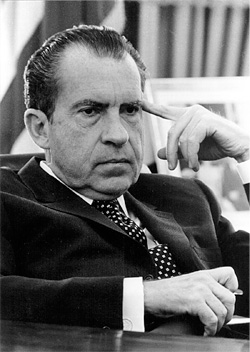
Richard Nixon
Thanks to all the propaganda and lies spread about cannabis, 29 states had banned the plant, and the federal government passed The Marihuana Tax Act of 1937 which effectively banned cannabis federally by enacting insane taxes and regulations on it.
Later, the government passed The Boggs Act of 1952 and The Narcotics Control Act of 1956 which enforced mandatory sentencing and increased punishment for possessing cannabis. These acts made first-time offenses a minium of two to ten years of jail time with a fine of up to $20,000.
In 1969, the US Supreme Court actually struck down the Marihuana Tax Act because they found that it violated the Fifth Amendment right against self-incrimination. However, the victory for cannabis users would not last long, because the government soon passed the Controlled Substance Act, which is still in effect today. While the law officially prohibited the use of cannabis for any purpose, it also eliminated mandatory minimum sentences and reduced simple possesion of all drugs from a felony to a misdemeanor. The CSA classifies cannabis as a Schedule 1 drug, which means it was deemed to have high potential for abuse and no accepted medical use.
Richard Nixon was the president who signed the act, and he would use drug criminalization to jail his political opponents, who tended to be hippies and people of the counter-culture movement. He also used it for racist means as he knew it was a way to go after minorities who were in a more lower class situation.
Decriminalization and Legalization
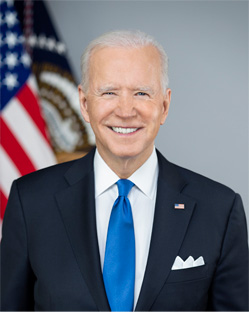
Joe Biden
While cannabis remains illegal under federal law, many states have decided to take matters into their own hands by loosening their laws around it. California was the first state to legalize cannabis for medical use in 1996, and ever since then more and more states started following suit. In 2012, Colorado and Washington became the first state to legalize it recreationally.
The grand majority of states have either decriminalized or legalized cannabis for medical and recreational use. There are still a number of them that haven't done anything yet, but that number is slowly dwindling. The latest states to pass legalization are Maryland and Missouri, which was decided during the 2022 midterm elections. Most states have legalized through ballot initiatives, but there are a few that have legalized it through the state legislature, such as Illinois.
The federal government has shown signs of change recently as well. The House of Representatives has passed many federal legalization bills under Democratic Party control, though those measures typically die in the Senate due to the votes not being there. However, there are signs that even the conservative Republican Party is starting to consider loosening up the laws a little bit. The most likely bill to go through right now is the SAFE act, which allows businesses in legal states access to banking systems, which would be huge as these businesses often have to operate on a cash-only basis.
Joe Biden has recently made executive actions to pardon all federal simple possession charges of cannabis off people's records and releasing them from federal prisons. He has also encouraged state governments to do the same. He also started the review process of the scheduling of cannabis, and it is to be determined where things go from there. So far, it seems that his administration at least acknowledges that cannabis does not belong on the Schedule 1 list, and there are good signs that it will either be lowered, or removed altogether. If it is descheduled completely, it will effectively legalize cannabis at the federal level, leaving legalization decisions completely up to the states. Time will tell, but progress is at least being made.